
Hi, I'm Darren W.. I live in Indiana. Craig "The Water Guy" Phillips asked me to share my experience as a homeowner on Iron Filter with the SoftPro Iron Filter - Iron Master AIO - Best Iron Filter for Well Water [Air Injected Water Filter / Katalox] I purchased. This is how my adventures played out. I hope this helps you in your decision.
Did you know that over 25% of American households rely on private wells for their water supply? If you're reading this, chances are you're dealing with the same rusty, metallic-tasting water nightmare that plagued my family for years. When I first noticed those telltale orange stains creeping across my white porcelain sink, I thought it was just a minor inconvenience. Boy, was I wrong.
Six months ago, I was at my wit's end with our https://www.softprowatersystems.com/collections/iron-well-water-filters well water situation. Every morning brought fresh evidence of iron contamination: rust-colored toilet bowls, orange-stained laundry, and that unmistakable metallic taste that made even coffee unbearable. My wife started buying bottled water for drinking, and our monthly grocery bill reflected this expensive Band-Aid solution.
After extensive research and testing three different iron filtration systems over the past two years, I can honestly say the SoftPro Iron Master has transformed our water quality beyond my expectations. But let me be clear from the start: this isn't a miracle cure-all, and it definitely requires commitment to proper maintenance.
The Iron Water Crisis That Started It All
Living in rural Indiana means well water is a way of life, but what I didn't expect was the gradual deterioration of our water quality over five years of homeownership. It started subtly – a slight orange tint in the toilet bowl that I dismissed as mineral buildup. Within eighteen months, the situation had escalated to a full-blown household crisis.
Our iron levels tested at 8.2 parts per million (PPM) when I finally had the water analyzed professionally. For context, the EPA's secondary standard recommends no more than 0.3 PPM for aesthetic reasons. We were dealing with nearly thirty times the recommended level. The ferrous iron (dissolved iron) in our water was oxidizing upon contact with air, creating the ferric iron (rust particles) that was staining everything in sight.
The financial impact was staggering. I calculated that we were spending an extra $180 monthly on bottled water, replacing stained clothing, and using excessive amounts of cleaning products to combat the orange buildup. Our dishwasher had developed permanent orange streaks on the interior, and our white laundry looked perpetually dingy despite multiple wash cycles.
But the real wake-up call came when our plumber pointed out iron buildup in our hot water heater during a routine inspection.
The sediment accumulation was reducing efficiency and potentially shortening the appliance's lifespan significantly. Iron bacteria had also begun forming slimy deposits in our toilet tanks – a clear sign that our iron problem was creating an environment for bacterial growth.
I'd tried pitcher filters (useless for this level of contamination), faucet-mounted filters (clogged within weeks), and even installed a basic sediment filter (which only caught visible particles, not dissolved iron). Each failed solution cost money and time while the underlying problem worsened.
Research Phase: Understanding Iron Filtration Technology
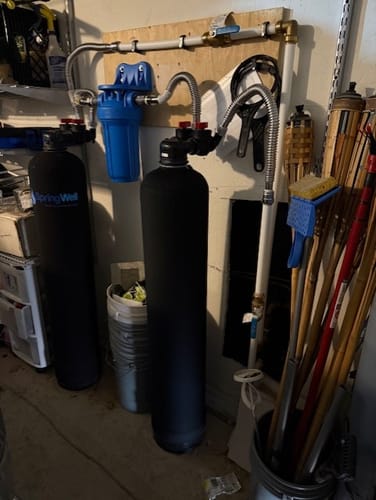
Determined not to waste more money on inadequate solutions, I spent three months researching iron filtration technologies. This education process was crucial because iron removal isn't as straightforward as basic filtration – it requires oxidation and subsequent removal of the oxidized particles.
I learned about three primary iron removal methods: air injection systems, chemical oxidation systems, and catalytic filtration media. Air injection systems introduce oxygen to convert ferrous iron to ferric iron, which can then be filtered out. Chemical oxidation uses chlorine or hydrogen peroxide for the same purpose. Catalytic media like Katalox Light performs oxidation and filtration in a single vessel.
The SoftPro Iron Master caught my attention because it combines air injection technology with Katalox Light media – essentially providing double-duty iron removal. The system injects air into the water stream, allows contact time for oxidation in a retention tank, then filters the oxidized iron through the Katalox media bed.
Sizing calculations were critical. With our household of four and peak flow demands of approximately 12 gallons per minute (during simultaneous showers and dishwasher operation), I needed a system rated for at least 15 GPM to avoid pressure drops. The Iron Master's 15 GPM capacity and 1.5 cubic feet of Katalox media seemed appropriately sized for our iron levels and flow requirements.
I also researched NSF certification standards. While the Iron Master isn't NSF certified as a complete system, the Katalox Light media carries NSF 61 certification for drinking water system components. This gave me confidence in the media's safety and performance capabilities.
The deciding factor was SoftPro's reputation for customer support and the system's modular design allowing future upgrades or modifications.
Unboxing and First Impressions
The Iron Master arrived via freight delivery in early March, packaged on a wooden pallet with industrial shrink wrap. I'd prepared space in our basement utility room, measuring twice to ensure adequate clearance for the 54-inch tall pressure tank and 62-inch filter vessel.
Unpacking revealed impressive build quality immediately. The pressure tank featured a heavy-duty steel construction with powder-coated finish, while the filter vessel used NSF-certified fiberglass with brass fittings. The air injection pump felt substantial – not the flimsy plastic components I'd seen on budget systems.
The control valve caught my eye with its digital display and programming capabilities. Unlike simple timer-based systems, this valve uses actual volume calculations and customizable backwash cycles. The instruction manual was surprisingly comprehensive, with detailed plumbing diagrams and troubleshooting guides.
Component inventory revealed thoughtful inclusion of installation hardware: brass fittings, flexible connectors, and even pipe thread compound. However, the bypass valve assembly required separate purchase – an unexpected $85 addition that should be mentioned prominently in product descriptions.
Initial concerns centered on the system's footprint. Even after measuring, seeing the actual equipment in my utility room made me realize how much space this setup requires. The pressure tank alone occupies roughly 4 square feet of floor space, and proper service clearance adds another 2 feet on all sides.
Installation Journey: Challenges and Solutions

I opted for professional installation despite considering DIY initially. The complexity of integrating the air injection pump, pressure tank, filter vessel, and control systems convinced me that professional expertise was worth the $450 installation cost.
My plumber, Mike, had previous experience with SoftPro systems, which proved invaluable. The installation required creating new branch lines from our main water supply, installing the bypass valve assembly, and running electrical service for the control valve and air pump. Total installation time was 6.5 hours due to some unexpected complications.
The main challenge arose from our home's original plumbing configuration. The existing water line entered our basement through a tight crawl space, requiring creative routing to accommodate the new system. Mike had to relocate our pressure switch and install additional unions to facilitate future maintenance.
Electrical requirements were straightforward – a dedicated 115V circuit for the control valve and air injection pump. The system draws minimal power (under 2 amps), so existing basement circuits could have handled the load, but code required dedicated service for permanently installed equipment.
Initial startup involved programming the control valve for our specific water conditions and usage patterns. We set the backwash cycle for every 3 days initially, planning to adjust based on actual performance. The air injection rate required calibration – too little air means incomplete oxidation, too much causes unnecessary pump wear.
The first backwash cycle was eye-opening.
Watching orange water flush from the drain line during the cleaning cycle provided visual confirmation that the system was capturing iron effectively. The backwash lasted approximately 12 minutes and consumed roughly 150 gallons of water – a significant consideration for households on wells with limited capacity.
Performance Analysis: Six Months of Real-World Results
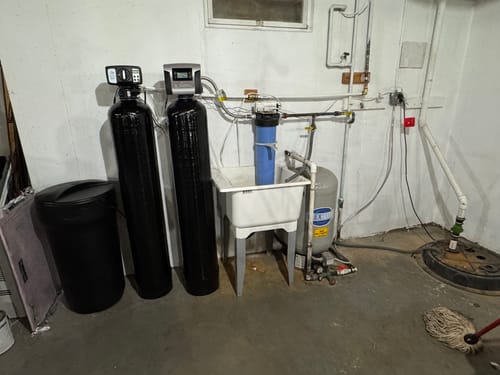
Testing our water quality became an obsession during the first month of operation. I invested in a calibrated iron test kit and tracked levels religiously to verify system performance. Pre-filtration iron levels remained consistent at 8.0-8.4 PPM, while post-filtration results dropped to 0.1-0.2 PPM consistently.
The transformation was immediate and dramatic. Within 48 hours of startup, our faucet water ran crystal clear without any metallic taste. The coffee test – always my benchmark for water quality – showed remarkable improvement. My wife commented that ice cubes no longer had that slight orange tint we'd grown accustomed to ignoring.
Laundry results exceeded expectations dramatically. White loads that previously emerged with orange tinges now retained their original brightness. I tested this by washing identical white towels with our old untreated water (stored in containers) versus the filtered water. The difference was striking – filtered water produced consistently white results while untreated water created the familiar orange staining.
Appliance performance improvements became evident within weeks. Our dishwasher's interior gradually returned to its original stainless steel appearance as existing iron deposits loosened and washed away. New spotting on dishes virtually disappeared, and our glassware regained its original clarity.
Flow rate performance met specifications admirably. Even during peak demand periods – simultaneous showers upstairs while running the dishwasher – I measured consistent 12-13 GPM flow at various fixtures. Pressure drops were minimal, typically 2-3 PSI across the system under normal operating conditions.
The air injection system operates quietly, contrary to my concerns about pump noise. The compressor cycles approximately every 15-20 minutes during heavy usage, producing a brief 30-second hum that's barely audible from our main living areas. The retention tank occasionally produces slight gurgling sounds as air and water mix, but nothing disruptive.
Seasonal testing revealed consistent performance across varying conditions.
Indiana's temperature fluctuations and seasonal water table changes didn't affect filtration efficiency noticeably. Summer usage increases required slight adjustments to backwash frequency, but overall system performance remained stable.
Daily Life Impact: Beyond Just Water Quality
The psychological relief of turning on any faucet without wondering what color water might emerge cannot be overstated. Six months later, I still occasionally pause when filling a glass, amazed by the consistently clear water that flows out.
Our cleaning routine simplified dramatically. Bathroom cleaning that previously required iron-specific cleaners and extensive scrubbing now involves basic maintenance. The orange ring that perpetually formed around our toilet bowl disappeared entirely within two weeks of system startup.
Kitchen confidence returned gradually. Cooking with our well water went from unthinkable to preferable (compared to the chlorinated municipal water we'd experienced elsewhere). Pasta water doesn't develop that metallic taste, and ice cubes are genuinely clear and flavorless.
Guests notice immediately, though politely. My brother-in-law, visiting from Chicago, commented unprompted that our water "tastes great" and asked about our filtration system. This external validation confirmed that the improvement wasn't just our imagination.
Laundry confidence revolutionized our clothing purchases and care. My wife no longer hesitates to buy white or light-colored items, and our existing wardrobe has gradually returned to its intended colors through repeated washing in iron-free water.
The unexpected benefit was improved skin and hair condition for our entire family.
Iron-laden water had been drying our skin and leaving our hair feeling coarse and lifeless. Within a month of filtered water usage, everyone noticed softer hair and less dry skin, particularly during Indiana's harsh winter months.
Cost Analysis: Investment vs. Returns
The total investment including equipment ($2,850), installation ($450), and bypass valve ($85) reached $3,385 initially. While substantial, breaking down costs reveals the long-term value proposition clearly.
Monthly operational expenses include electricity (approximately $8), periodic Katalox media replacement (estimated $15 monthly when amortized), and increased water usage for backwashing (roughly $12 monthly for our well water situation). Total monthly operating costs average $35.
Savings calculations tell an impressive story. We eliminated $180 monthly bottled water purchases immediately. Reduced cleaning product usage saves approximately $25 monthly, and decreased laundry re-washing (for iron staining) saves detergent and utility costs worth roughly $15 monthly. Our projected appliance lifespan extension adds value that's harder to quantify but certainly significant.
The payback period calculates to roughly 18 months when considering direct savings alone. Including appliance protection and quality-of-life improvements, the system justified its cost within the first year of operation.
Compared to our previous solutions – pitcher filters ($40 monthly), faucet filters ($25 monthly), and bottled water ($180 monthly) – the Iron Master's operational costs are remarkably reasonable. The previous "solutions" were costing $245 monthly while providing inadequate results.
Long-term value becomes even more attractive when considering that Katalox media typically lasts 8-12 years with proper maintenance.
Honest Assessment: What Could Be Better
Six months of ownership reveals several limitations worth discussing honestly. The system's physical footprint remains my primary concern – this equipment requires substantial basement or utility room space that many homes simply don't have available.
Backwash water consumption surprised me despite research preparation. At 150 gallons every three days, the system uses roughly 1,500 gallons monthly for cleaning cycles. For households with limited well capacity or environmental concerns, this represents a significant consideration.
The control valve programming, while comprehensive, assumes more technical knowledge than average homeowners possess. I spent considerable time understanding optimal settings, and I'm still not confident I've achieved perfect calibration for our specific conditions.
Power dependency means water treatment stops during electrical outages. While this doesn't affect existing filtered water in our pressure tank, extended outages could result in untreated water reaching our fixtures when the tank empties.
Maintenance access could be improved. The filter vessel's location requires maneuvering around other basement equipment for media replacement or valve service. Better planning during installation could have addressed this, but the system's size limits placement options.
The air injection pump, while quiet, does introduce another mechanical component that could potentially fail.
Having backup parts or understanding repair procedures becomes important for long-term ownership confidence.
Customer support, while generally responsive, operates during limited hours. When questions arose during weekend installation, getting technical guidance required waiting until Monday morning.