
Hi, I'm Qvan Rov. I live in New York. Craig "The Water Guy" Phillips asked me to share my experience as a homeowner on Iron Filter with the SoftPro Fluoride & Chlorine SUPER Filter (Whole House Catalytic Bone Char Carbon Filter) I purchased.
This is how my adventures played out. I hope this helps you in your decision.
The Water Crisis That Changed Everything
Did you know that municipal water treatment doesn't remove everything you think it does?
I learned this the hard way last spring when my family started experiencing issues I never connected to our water. My wife complained about her hair feeling dry and brittle after every shower. Our coffee tasted off, even with premium beans. Most concerning was the chlorine smell that hit you when you walked into our bathroom after someone showered.
Living in New York, I assumed our water was fine. The city meets federal standards, right?
But then my neighbor, a chemistry teacher, mentioned testing his water and finding fluoride levels that concerned him for his young children. That conversation sparked my research journey into what was actually flowing through our pipes.
I started noticing things I'd previously ignored. White residue on our glassware that wouldn't come off. A metallic aftertaste in our drinking water. The way our vegetables seemed to lose their vibrant color when we washed them.
The breaking point came when my wife developed what appeared to be contact dermatitis. After ruling out detergents and soaps, her dermatologist casually mentioned that chlorine and other water treatment chemicals could be irritating her sensitive skin.
My Deep Dive Into Water Treatment Research
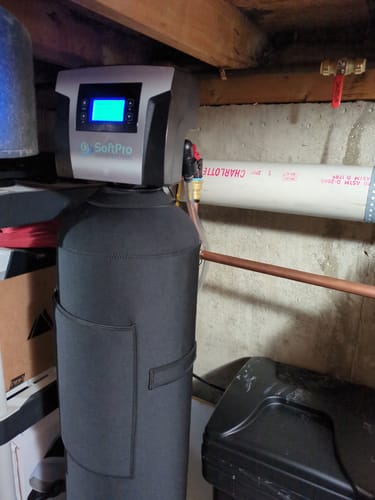
That doctor's visit sent me down a rabbit hole of water quality research. I spent weeks learning about municipal water treatment processes, and honestly, I was shocked at what I discovered.
What shocked me most about fluoride?
Municipal water systems add fluoride for dental health, but many families prefer to control their fluoride intake through toothpaste and dental care rather than consuming it in every glass of water. I learned that fluoride removal requires specialized filtration—standard carbon filters don't touch it.
The chlorine issue was even more complex. While chlorine kills harmful bacteria during transport, it continues affecting your body when you drink, cook, and bathe with treated water. Chlorine can form disinfection byproducts (DBPs) like trihalomethanes, which the EPA regulates but doesn't eliminate.
I tested our water with a comprehensive kit that measured:
• Chlorine levels: 2.8 ppm (within legal limits but higher than I wanted)
• Fluoride concentration: 0.9 ppm (again, legal but not what we preferred)
• Total dissolved solids: 340 ppm
• pH: 7.8 (slightly alkaline)
• Trace metals including lead: 8 ppb (under EPA action level of 15 ppb but still present)
These numbers meant our water was "safe" by government standards, but that didn't align with what we wanted for our family's daily consumption and exposure.
Why I Chose SoftPro's Catalytic Bone Char Technology
After researching dozens of whole-house filtration systems, I kept coming back to the science behind catalytic carbon combined with bone char filtration.
What makes catalytic carbon different from regular carbon?
Regular activated carbon works through adsorption—contaminants stick to the carbon's surface. Catalytic carbon takes this further by actually breaking down certain contaminants through chemical reactions. This makes it particularly effective against chloramines, which many water systems now use instead of straight chlorine because chloramines last longer in the distribution system.
The bone char component fascinated me from a scientific perspective. Bone char has been used for centuries in water treatment, and it's uniquely effective at removing fluoride through a process called chemisorption. Unlike physical filtration, chemisorption creates chemical bonds between the fluoride and the Fluoride Filter System bone char, permanently removing it from the water.
SoftPro's upflow design also made sense for our situation. Traditional downflow filters can create channeling, where water finds the easiest path through the media instead of contacting the entire filter bed. Upflow forces water through the entire media bed more evenly, maximizing contact time and filtration efficiency.
The system I selected handles 12 GPM flow rate, which supports our household's simultaneous water usage without pressure drops. The catalytic carbon and bone char media bed contains approximately 2.5 cubic feet of filtration media—enough to treat our family's water consumption for 3-5 years depending on usage and contamination levels.
Installation Day: What I Learned the Hard Way

I'm fairly handy, but I decided to hire a licensed plumber for this installation. Best decision I made throughout this entire process.
The system required installation on our main water line after the pressure tank but before any branch lines. This meant shutting off water to our entire house for about four hours. My plumber explained that the upflow design requires specific inlet and outlet positioning—the water enters at the bottom and exits at the top, which is opposite of many conventional filters.
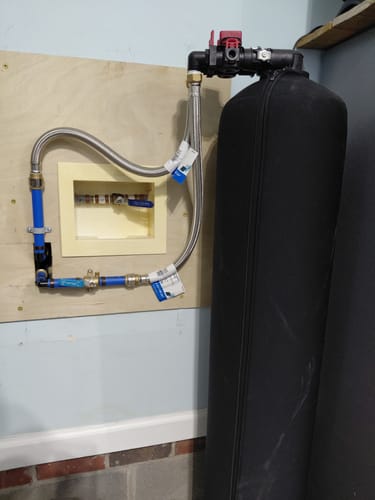
We had to install a bypass valve system, which I'm grateful for now. During the initial startup, we needed to backwash the system to remove any fine particles from the media. The bypass allowed us to continue using water in the house while the system went through its initial cleaning cycles.
The control valve is programmable, and my plumber walked me through the settings. We configured it for:
• Backwash frequency: Every 7 days initially (adjustable based on usage)
• Backwash duration: 12 minutes
• Rinse cycle: 5 minutes
• Service flow rate: 12 GPM maximum
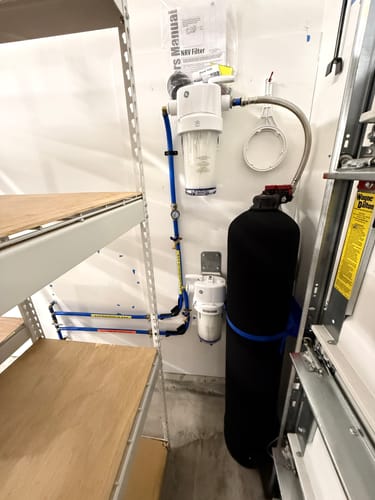
One surprise was the space requirement. The system stands about 54 inches tall and requires clearance above for media replacement. Make sure you measure your installation area carefully—we had to relocate some shelving in our utility room.
The First Week: Immediate Changes I Noticed
Could I really taste the difference immediately?
Absolutely. The chlorine taste and odor disappeared within 24 hours of bringing the system online. Our morning coffee revealed flavor notes I'd never noticed before—turns out chlorine was masking the subtleties of our beans.
My wife noticed changes in her hair within three days. She said it felt softer and less tangled after washing. Her skin irritation began improving by the end of the first week, though her dermatologist cautioned that skin recovery takes time.
The most dramatic change was in our cooking. Vegetables retained their bright colors when washed and cooked. Pasta water didn't have that slight chemical smell anymore. Even ice cubes from our refrigerator tasted cleaner—I hadn't realized the chlorine was affecting ice quality too.
I tested the water after one week:
• Chlorine: Undetectable (down from 2.8 ppm)
• Fluoride: 0.1 ppm (reduced from 0.9 ppm)
• TDS: 298 ppm (reduced from 340 ppm)
The fluoride reduction impressed me most. Bone char filtration removed over 85% of the fluoride, which aligned with my research on this technology's effectiveness.
Six Months of Real-World Performance Data
Now that I've lived with this system through different seasons and usage patterns, I can share some honest performance insights.
How consistent is the filtration over time?
Very consistent, with some interesting observations. During summer months when we used more water for gardening and lawn care, I noticed the system worked harder. The backwash cycles sometimes showed slightly more sediment, but filtered water quality remained excellent.
I test our water monthly now, and the results have been remarkably stable:
Month 1: Chlorine undetectable, Fluoride 0.1 ppm
Month 3: Chlorine undetectable, Fluoride 0.15 ppm
Month 6: Chlorine undetectable, Fluoride 0.2 ppm
The slight increase in fluoride levels over time is normal as the bone char becomes saturated, but we're still achieving over 75% reduction after six months of use.
Water pressure throughout our house remained excellent. Even with simultaneous showers, dishwasher, and washing machine running, we maintain 45 PSI at all fixtures. The upflow design really does minimize pressure drop compared to our previous point-of-use filters.
One unexpected benefit: our water heater efficiency improved. Without chlorine constantly attacking the heating elements and creating mineral buildup, our electric water heater cycles less frequently. Our average monthly electric bill dropped by about $15-20, which partially offsets the system's operating costs.
Operating Costs: The Complete Financial Picture
Let me break down the real costs of ownership, because this information was hard to find when I was researching.
Initial system cost: $2,847 (including shipping)
Installation: $385 (plumber, 4 hours)
Bypass valve and fittings: $127
Total upfront investment: $3,359
What about ongoing expenses?
Monthly costs are lower than I expected:
• Electricity for control valve: Approximately $3-4 per month
• Water usage for backwash: About 180 gallons monthly ($8-10 depending on local rates)
• No filter cartridges to replace regularly
The media replacement is the significant long-term cost. SoftPro estimates 3-5 years for media life depending on water quality and usage. Replacement media costs approximately $400-500, which works out to $8-14 per month when amortized.
Total monthly operating cost: $19-28
Compare this to bottled water costs for a family of four (approximately $60-80 monthly) or point-of-use filter replacements (RO systems can cost $200 annually for filter sets), and the economics make sense.
The health and lifestyle benefits are harder to quantify financially, but my wife's reduced skin care expenses and our improved coffee experience add value beyond the numbers.
Honest Assessment: What Could Be Better
After six months, I can identify several areas where this system could improve, though none are dealbreakers for our family.
What frustrates me most about the maintenance schedule?
The backwash cycles are loud. Not extremely loud, but noticeable when they run at 2 AM. The timer allows you to set backwash times, and I've moved ours to 6 AM, but I wish the system had a "quiet mode" for the pump operation.
The control interface is functional but not intuitive. Programming changes require consulting the manual each time. A more user-friendly digital display would improve the ownership experience significantly.
Media replacement will require professional service or significant DIY skills. The system needs to be drained, the tank opened, old media removed, and new media installed with proper stratification. This isn't a simple cartridge change like point-of-use filters.
Water waste during backwash bothers my environmentally conscious side. Each backwash cycle uses 50-60 gallons, which adds up over a year. However, this waste is necessary for maintaining filtration effectiveness and preventing media fouling.
The fluoride removal, while excellent, isn't 100%. Families seeking complete fluoride elimination might need additional point-of-use treatment for drinking water. The bone char removes most fluoride, but trace amounts remain.
Initial startup required patience. The first week involved several manual backwash cycles to fully condition the media, and the water had a slight earthy taste for 2-3 days. This resolved completely, but don't expect perfect results on day one.
Final Verdict: Would I Choose This System Again?
Absolutely, and here's why this investment made sense for our family's specific needs.
What convinced me this was the right choice?
The combination of catalytic carbon and bone char addresses our primary concerns—chlorine, fluoride, and general water quality—in a single, whole-house system. Alternative solutions would require multiple point-of-use filters or a more complex multi-stage system.
The upflow design and robust construction suggest this system will serve us reliably for many years. Build quality is excellent, with heavy-duty components that feel designed for long-term service rather than quick replacement.
Performance has exceeded expectations. Water quality improvements are noticeable daily, and the system handles our peak usage without pressure issues. The health benefits for my wife's skin condition alone justify the investment.
Operating costs are reasonable when compared to alternatives. While the upfront investment is significant, the long-term cost per gallon is competitive with other whole-house solutions and far better than bottled water.
Who should seriously consider this system? Families with municipal water who want to reduce chlorine and fluoride exposure throughout their home. Anyone with sensitive skin or respiratory issues that might benefit from reduced chemical exposure. Households that value water quality for cooking and drinking but don't want the maintenance hassle of multiple point-of-use filters.
This system works best for people who understand it's a long-term investment in water quality rather than a quick fix. The upfront cost and professional installation requirement mean you need to be committed to whole-house filtration rather than experimenting with water treatment.
After six months of daily use, I'm confident this was the right choice for our situation. The water quality improvements are real, measurable, and consistent. My family notices the difference every day, and I expect years of reliable service from this well-engineered system.